
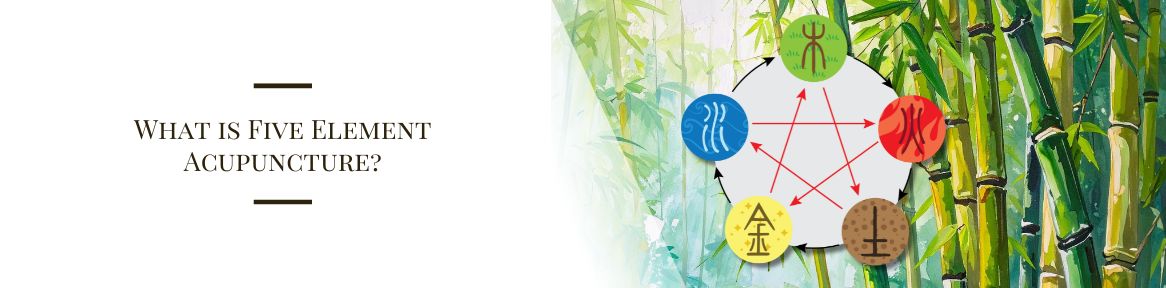
Five Element Acupuncture is a classical style of East Asian medicine that organizes diagnosis and treatment around the dynamic interplay of five phases/elements: Wood, Fire, Earth, Metal, and Water. Each element is associated (in this framework) with organ networks, emotions, sensory patterns, and seasonal cycles. Treatment aims to restore harmony among these elements when one becomes predominant or deficient.
In modern practice, the best-known lineage is Worsley Classical Five-Element Acupuncture, which emphasizes discerning a patient’s primary “causative factor” and using a focused set of points, along with careful attention to color, sound, odor, and emotion in diagnosis.
While Five Element theory comes from classical Chinese sources, it’s important to note that “acupuncture” is an umbrella term with many styles (e.g., TCM, Japanese, scalp, auricular). Much of the scientific literature evaluates acupuncture as a modality, not a specific lineage; consequently, direct head-to-head evidence for Five Element methods per se is still limited.
How a Session Typically Looks
A Five Element visit often involves an extended intake to identify the predominant element imbalance and related emotional/physiologic signatures, followed by needling a relatively concise set of points chosen to correct that imbalance. Practitioners may prioritize constitutional treatment over symptom-chasing, and they often work within seasonal cycles (e.g., Wood in spring). Training programs in the Worsley tradition explicitly teach these sensory diagnostics and focused treatment strategies.
Potential Benefits
Clinically, people pursue Five Element care for many of the same reasons they seek acupuncture in general:
- Chronic pain (low-back, neck, knee osteoarthritis)
- Headache and migraine
- Stress, mood concerns, and sleep
- Functional somatic symptoms (persistent symptoms without a clear biomedical etiology)
- Overall well-being (constitutionally oriented care)
Chronic Primary Pain
Large evidence syntheses (e.g., NICE evidence reviews for chronic primary pain) report that acupuncture can reduce pain and improve quality of life compared with usual care in the short term and performs better than sham in several analyses, though certainty varies from low to moderate depending on outcome and timepoint. These reviews do not distinguish Five Element from other styles, but they support acupuncture as a reasonable, non-pharmacologic option within a multimodal plan.
For chronic nonspecific low-back pain, a Cochrane review similarly suggests acupuncture may provide short-term pain relief compared with no treatment/usual care; evidence quality ranges from low to moderate, and heterogeneity is high, again, style-agnostic.
Migraine Prevention
Systematic reviews find that acupuncture reduces migraine frequency more than sham and, in some analyses, more than standard drug prophylaxis immediately after treatment (with effects attenuating at follow-up). Safety profiles compare favorably to medication prophylaxis. These bodies of evidence don’t isolate Five Element techniques, but they support acupuncture as a viable preventive strategy.
Depression and Mood
Updated systematic reviews and meta-analyses report that acupuncture, whether used alone or alongside standard care, can reduce depressive symptom scores versus comparators, with variability in study quality and protocols. Most trials use standard/manual acupuncture rather than a strictly Five Element approach; nevertheless, they suggest potential benefit and good tolerability.
There is some Five Element–specific work in primary care: UK pragmatic trials explored adding Five Element acupuncture to usual care among patients with persistent, medically unexplained symptoms; participants receiving this adjunct reported improvements in well-being and symptom burden, though sample sizes were modest and findings warrant replication.
Functional Persistent Physical Symptoms
As noted above, the British Journal of General Practice trial assessing adjunctive Five Element acupuncture for patients with persistent symptoms found improvements in certain patient-reported outcomes compared with usual care alone over the study period. Because trial methods were pragmatic and focused on global well-being, the results are hypothesis-generating rather than definitive.
Mind–Body Approaches
Some programs integrate Five Element music therapy with acupuncture for mood and post-stroke depression. Early randomized studies, many from China, suggest additive improvements in depressive symptoms and quality of life compared with control conditions, but methods vary, and generalizability is uncertain. These are intriguing, adjunctive lines of inquiry rather than practice-changing evidence at this point.
Bottom Line
Five Element Acupuncture offers a coherent, classical framework for treating the whole person by rebalancing elemental dynamics. Contemporary evidence most strongly supports acupuncture in general for chronic pain and migraine prevention, with emerging, but still limited, Five Element–specific data in primary care and adjunctive mind-body contexts. For patients who resonate with its philosophy and for clinicians building individualized, multimodal plans, Five Element Acupuncture is a reasonable, usually safe option, provided expectations are realistic and care is coordinated.